How to do cold outreaches that feel good
2026-08-24
All of the jobs I’ve ever held – the ones that make people say, whoa, that’s the coolest thing I’ve heard – started from a cold outreach.
None of them came from clicking "Apply." Every single one was a door I pitched and built for myself from scratch.
Most people think cold outreach feels awkward or desperate, which means they’re probably doing it wrong.
Here is how I do it, starting with a conversation I had at a summer BBQ recently...
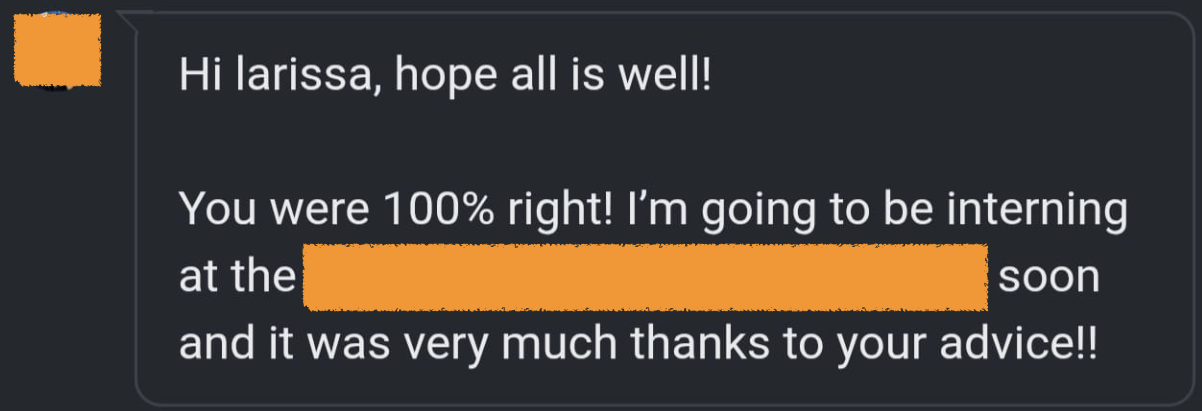
A university student was interested in a specific organization, but their site listed zero internships. He mused if he could find an email address and just write in to ask for an opportunity. I told him, YES, DO IT.
Two weeks later, I got this message from him:
The “Side Door” Mindset
This post is about cold outreaches, but it’s really about creating opportunities for yourself.
Let me explain.
Job openings are labeled doors. They say, “to enter [X field or Y org], you must enter through here.” This makes it easier for an org to hire people. But it makes it harder for you to stand out, because the labeled doors get all the traffic.
Instead, create side doors for yourself. Look for any window or crack that you can turn into a door.
I promise you, very few people are doing this.
The Leaf-Raking Test
Think of cold outreach as targeted service delivery, not a plea for favors.
Here are three scenarios:
A. You knock on someone’s front door. They answer. You stand there looking at each other.
B. You knock, they answer, and you say, can I rake your leaves?
C. You knock, they answer, and you say, hey I noticed you have leaves piling up in your yard. I rake leaves and take them away. Do you want some help with your leaves?
Scenario A is too vague. Don’t do cold outreach that leaves you both unclear why you’re knocking on the door. You’re wasting everyone’s time.
Scenario B doesn’t offer any context (Do they actually need leaf-raking services? Who are you to rake their leaves?) and comes off as desperate.
Scenario C has you establishing who you are (someone who is an expert in raking leaves), why you’re knocking on their door (you noticed they have leaves in their yard), and you offering your services in a specific and timely way.
When you’re working on a cold outreach, consider whether your message feels like A, B, or C. Amend it to make it feel like C.
I use this analogy because it’s easy to get all up in our heads when we have to make asks. It’s not that complicated. Liken it to raking leaves.
How to write a cold outreach message
How to do it:
1. List the obvious doors - Start by listing the well-known orgs you already follow and admire.
2. Find the hidden alternatives - Find the smaller, less visible outfits doing similar work. Use the internet. Ask seasoned veterans of the industry. Find the email address of someone who works there.
3. Pitch yourself:
• State who you are
• Explain your interest in the org
• Highlight 1-2 relevant skills or experiences in your background
• Ask if they offer internships/jobs/contract work, depending on what's appropriate for you
• Pitch 1-3 specific ideas for how you can help them right now.
Sidebar: The value of pitching ideas
1. It filters your own interest: If drafting ideas for an organization feels like pulling teeth, you don't actually want to work there. If the ideas stream out effortlessly, you’ve found something worth pursuing.
2. It signals initiative. It demonstrates proactivity, creativity, and a willingness to own your scope from the get-go. At best, you will present a good, novel idea and the company will appreciate that you’re delivering value before you are even hired. At worst, your ideas will be wildly inapplicable, but that won’t matter. You will stand out from all the other applicants that are not proposing any ideas and who, compared to you, look like they're sitting on their butts, waiting to be handed tasks.
3. It lowers their mental effort. If you’re pivoting careers, it’s a lot to expect an employer to connect the dots on how to use you. Pitching ideas helps them see a clear path from where you are to become an active member of the team.
Overcoming Mental Roadblocks
1. “It feels too forward.” It takes courage to bridge the gap between silence -> conversation. Striking up a conversation at the playground, at a networking event, on a shared taxi ride. I won't deny that it can all feel a little socially scary. But just think about the rich connections that lie on the other side.
2. “I don’t feel confident enough.” Confidence is not a requirement for writing an email. The confidence will follow once you see responses coming in.