BLOG
How to Figure Out the Real Reason You're Stuck
2025-11-27
I often meet people with some version of: “I’m in a pretty good job. I’m senior level. I should be happier, but I’m not. I’m not fulfilled. What happened to the idealistic version of me before I went to business school? Now it’s so hard to change.” I hear self-blame, as if it’s their fault that they pursued comfort or security or that they “sold out.” I also hear frustration, because even if they wanted to change directions now, it feels near impossible. And then they tell me that they’ve admired my career path. They’ve been inspired by me marching to the beat of my own drum. Now that I do career coaching, that's why they reached out.
This logic both flatters me and confuses me because it sounds like I could teach people how to march to the beat of their own drum. But I don’t think that is my superpower. I think the only thing that I know how to do better than others is to defend my needs. Today, I’ll try to explain what I mean.
Why Your Lower Needs Block Your Higher Goals
Abraham Maslow came up with his hierarchy of needs to explain human motivation. It looks like this:
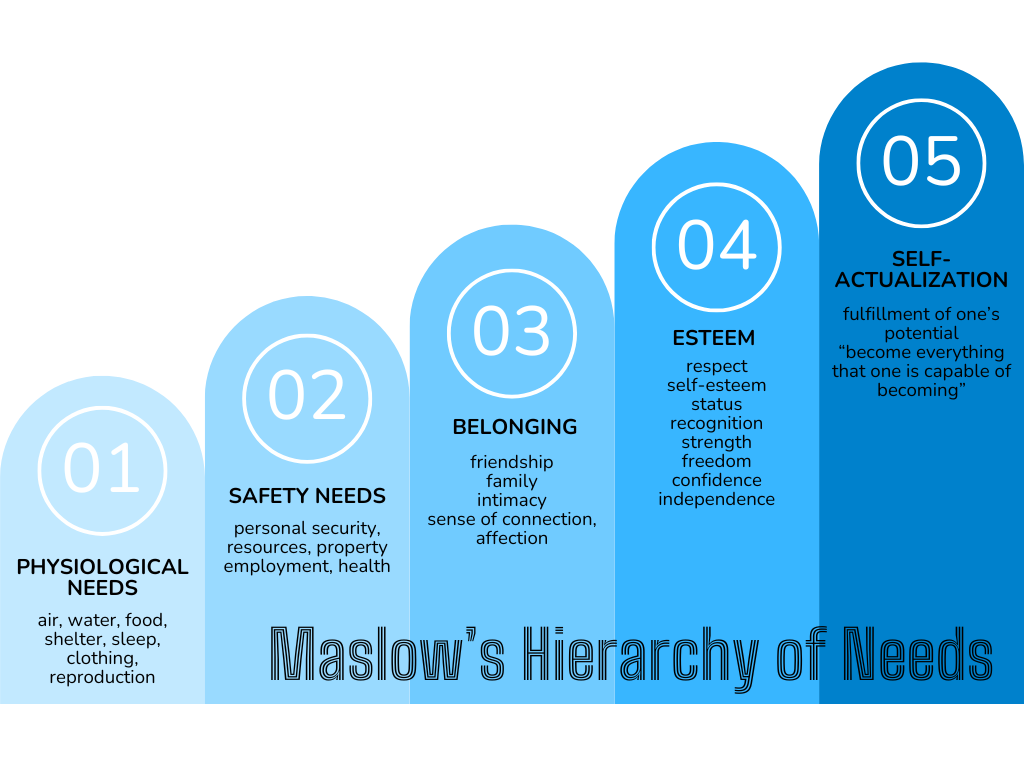
If you look at his original paper, one idea becomes clear: need-fulfillment is the exclusive organizer of behavior. People do what they do to secure a need. Only when that need is secured does a higher level need emerge.
“It is quite true that man lives by bread alone -- when there is no bread. But what happens to man's desires when there is plenty of bread and when his belly is chronically filled? At once other (and 'higher') needs emerge and these, rather than physiological hungers, dominate the organism. And when these in turn are satisfied, again new (and still 'higher') needs emerge and so on. This is what we mean by saying that the basic human needs are organized into a hierarchy of relative prepotency.”
People literally cannot contemplate, let alone successfully pursue, higher-level needs until the lower-level ones feel secure. In a career context, this isn't necessarily about answering “Where will I sleep tonight?” It looks like: Do the people around me approve of what I’m doing? Do I belong? Am I seen as competent, respectable, and safe?
Somebody who chose a prestigious, well-paid job might think they “sold out,” but in reality, they were meeting critical level-2 and level-3 needs: security, belonging, approval, social standing. Until those needs feel steady, it’s almost impossible for the mind to make space for level-4 and level-5 questions like autonomy, purpose, and self-actualization. Once the base layers are solid — once someone knows they are safe, respected, and socially accepted — then the higher needs naturally start to emerge.
Protect What Feels at Risk
So, for all of those thinking “I find my job so boring, but I can’t seem to bring myself to pursue more exciting opportunities,” the path forward isn’t to blame yourself for being lazy or undisciplined. It also doesn't work to sacrifice a lower level need in pursuit of a higher one. (Actually, it could work, perhaps for quite a long time, depending on your pain tolerance. But why make it so hard on yourself....)
Instead, first congratulate yourself. If your sights are now set on thriving, it must mean you've gotten pretty good at surviving. High five. Next, the gentle question to ask is, how can I continue to defend basic needs while pursuing higher needs like autonomy and fulfillment?
Turning Theory Into Practice
In practice, this question means digging deep to identify the basic need your system thinks will be threatened if you pursue autonomy or growth or fulfillment. We surface that need, examine it, and make sure it’s being supported before pursuing any BIG DREAM plan.
This is why one of my clients was surprised when I advised her to slow down and do the bare minimum while exploring her next venture. She expected I’d tell her to hustle, to tell her to suck it up and push through. But she didn’t have a discipline problem or an idea problem — she had a safety problem. Launching her last venture involved years of overwhelming stress. Now that she finally had stability, her system refused to let her dive back into a vortex of overwork.
Our work was helping her see that growth and stimulation don’t have to come at the cost of her health or wellbeing. Instead of diving into a dark hole of “founder mode” from which she would emerge with the life force sucked out of her (I kid I kid), we brainstormed how it was possible to embark on the new venture as a seasoned founder in the spirit of lightness, looseness, and playfulness. She remembered that always, at any moment, she had the power to make sure that the “base layers” of her needs pyramid remained protected. With that, suddenly, almost magically, my client found it was easy to start strategizing for the next venture.
Trying to change something but keep getting stuck? I made a quick 10-minute worksheet to help you spot your Defender Need.
If you identified the defender pattern keeping you stuck and want to shift it, then apply for a free strategy session with me.